
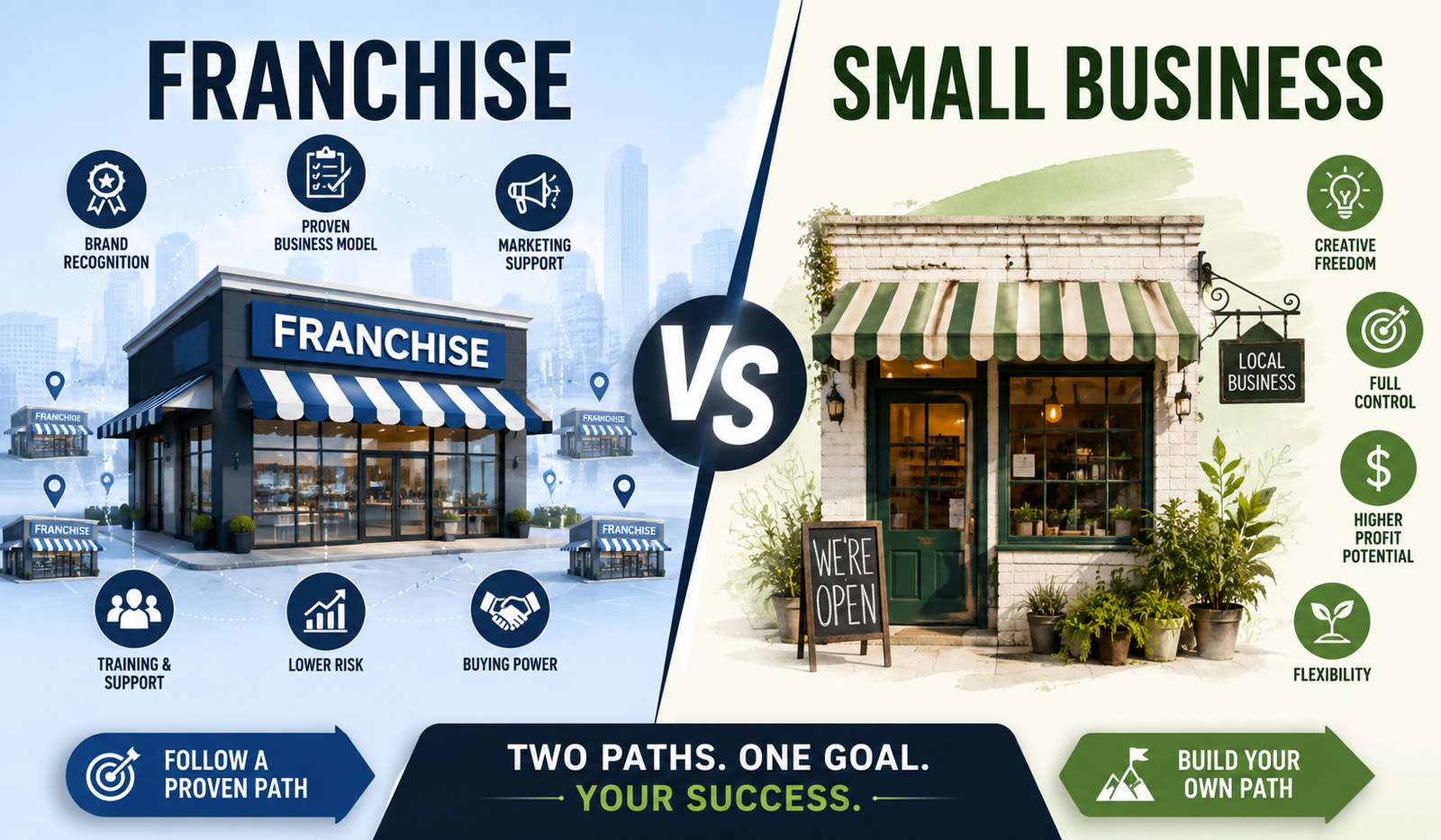
When I first started exploring different business opportunities, one of the biggest questions I faced was whether I should invest in a franchise or build a business completely from scratch. At first glance, both options seemed attractive. A franchise offered a proven business model, brand recognition, and support from an established company. On the other hand, a small business promised freedom, creativity, and the possibility of building something entirely my own.
Over the years, I have spent a significant amount of time researching both paths, speaking with business owners, analyzing costs, and understanding the challenges that entrepreneurs face. What I discovered is that there is no universal answer. The right choice depends on your goals, budget, risk tolerance, and personal preferences.
In this guide, I will compare franchise vs small business ownership in detail. I’ll share what I learned, explain the advantages and disadvantages of each option, and help you determine which path may be the best fit for your entrepreneurial journey.
Whether you’re considering a franchise investment or planning to launch an independent business, this comparison will give you a realistic picture of what to expect.
Franchise vs Small Business: Quick Comparison Table
| Factor | Franchise | Small Business |
| Startup Cost | Usually higher due to franchise fees | Can be lower depending on industry |
| Brand Recognition | Established brand awareness | Must build reputation from scratch |
| Business Control | Limited flexibility | Full control over decisions |
| Training & Support | Extensive support provided | Self-directed learning |
| Marketing | National and local support | Owner handles all marketing |
| Risk Level | Lower operational uncertainty | Higher uncertainty initially |
| Profit Potential | Limited by fees and rules | Potentially higher margins |
| Expansion Opportunities | Easier replication | Requires creating systems yourself |
| Creativity | Restricted by franchise guidelines | Unlimited flexibility |
What Is a Franchise?
When I first looked into franchise opportunities, I was attracted by the idea of following a proven system rather than figuring everything out on my own. A franchise is essentially a business arrangement where an entrepreneur purchases the right to operate under an established brand.
Instead of creating products, services, and operating procedures from scratch, the franchise owner follows systems developed by the parent company, commonly known as the franchisor.
Popular examples include fast-food restaurants, fitness centers, cleaning services, and retail stores. When someone buys a franchise, they gain access to the brand name, business processes, training programs, and ongoing support.
Understanding the Franchise Business Model
One thing I quickly realized is that the franchise business model is designed to reduce guesswork. The franchisor has already tested the concept in multiple markets and refined its operations over time.
As a franchise owner, you are essentially implementing a blueprint that has already demonstrated success elsewhere.
Typically, the relationship works like this:
- The franchisor owns the brand.
- The franchisee pays fees for the right to use that brand.
- The franchisor provides training and support.
- The franchisee follows established operational guidelines.
This arrangement allows entrepreneurs to start with a framework that has already been proven in the marketplace.
How Franchises Generate Revenue
Before considering any franchise investment, I believe it’s important to understand how the financial structure works.
Most franchises involve three major costs:
Initial Franchise Fee
This is the upfront payment made to join the franchise network. Depending on the industry, this fee can range from a few thousand dollars to hundreds of thousands of dollars.
Royalty Fees
Many franchisors collect ongoing royalties based on a percentage of monthly revenue. This means you’ll continue paying the franchisor even after your business becomes profitable.
Marketing Contributions
Many franchise systems require owners to contribute to regional or national advertising campaigns. While this can improve brand visibility, it also adds to operating expenses.
My Thoughts on Why Many New Entrepreneurs Choose Franchises
From what I have observed, many first-time business owners choose franchises because they want guidance and structure.
Starting a business can feel overwhelming. There are countless decisions to make regarding operations, marketing, staffing, inventory, pricing, and customer service. A franchise reduces much of that uncertainty by providing proven systems.
For entrepreneurs who value support and predictability, a franchise can feel like a safer starting point than building an entirely new business.
What Is a Small Business?
While franchises offer structure, I have always admired the freedom that comes with owning a small business.
A small business is independently owned and operated. Rather than following a franchisor’s rules, the owner creates the brand, develops business strategies, and makes all major decisions.
Examples include local restaurants, digital marketing agencies, consulting firms, retail stores, landscaping companies, and countless other ventures.
Unlike a franchise, there is no parent company dictating how the business should operate.
Understanding Independent Business Ownership
When I think about small business ownership, the word that comes to mind is freedom.
The owner has complete authority over:
- Branding
- Pricing
- Marketing
- Product development
- Hiring decisions
- Expansion plans
This flexibility allows entrepreneurs to adapt quickly to market changes and experiment with new ideas.
Of course, freedom also comes with responsibility. Every success and every mistake belongs to the business owner.
How Small Businesses Operate
One major difference I noticed while researching independent businesses is that each company develops its own systems.
There is no operations manual waiting to guide you.
Owners must learn how to:
- Attract customers
- Build a brand
- Create marketing campaigns
- Manage finances
- Hire employees
- Develop products and services
This process can be challenging, especially during the early stages. However, it also creates opportunities for innovation and long-term growth.
Why I Believe Small Businesses Offer More Freedom
One reason many entrepreneurs prefer independent business ownership is the ability to build something unique.
If I owned a small business, I could experiment with new products, change my branding strategy, adjust pricing, and pivot whenever market conditions change.
A franchise owner often needs approval before making significant changes.
For people who enjoy creativity and independence, a small business can be incredibly rewarding.
Franchise vs Small Business: The Core Differences
After studying both business models, I realized that the decision often comes down to one simple question:
Do you want freedom or structure?
A franchise provides structure through established systems, while a small business provides freedom through independent ownership.
Let’s examine the biggest differences.
Ownership Structure
In a franchise, you own the location but operate within the franchisor’s rules and guidelines.
In a small business, you own the entire brand and have complete authority over business decisions.
Decision-Making Authority
One of the biggest differences between franchise vs small business ownership is control.
Franchise owners must follow company policies regarding products, branding, marketing, and operations.
Small business owners can make decisions whenever they see opportunities for improvement.
Branding and Marketing
Franchises benefit from existing brand recognition, while small businesses must build credibility from the ground up.
However, small businesses have greater flexibility when developing their marketing strategies.
Training and Operational Support
Franchises generally provide comprehensive training programs and ongoing support.
Small business owners often learn through experience, research, networking, and trial and error.
Financial Responsibilities
Although franchises may generate revenue faster due to brand recognition, they often include ongoing fees that reduce profitability.
Small businesses avoid franchise fees but may spend more time building awareness and customer trust.
Long-Term Growth Opportunities
Both models can be successful.
A franchise may offer faster initial growth due to established systems.
A small business may provide greater long-term flexibility and potentially higher profit margins because there are no royalty payments.
The challenge is determining which approach aligns best with your personal goals and risk tolerance.
Also Read About :- Wix vs Shopify (2026): Which Platform Is Better for Your Online Store?