
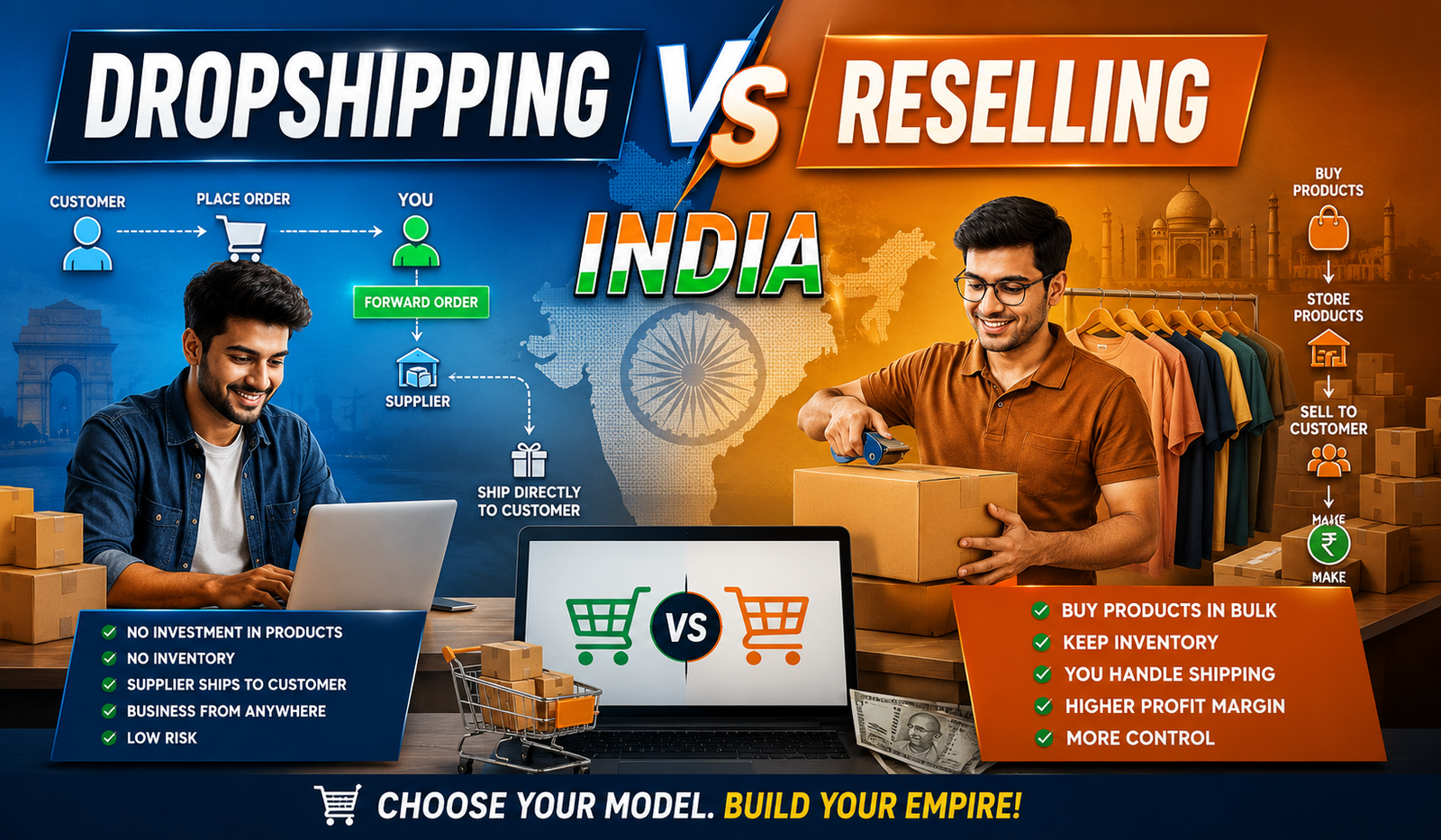
When I first started exploring ways to earn money online, I kept bumping into two terms everywhere dropshipping and reselling. YouTube videos made both sound like the path to financial freedom. WhatsApp groups had people swearing by reselling on Meesho. Instagram reels had 22-year-olds claiming they built a “6-figure dropshipping store” overnight. I was genuinely confused about where to begin, and honestly, a little overwhelmed.
I am from a middle-class background where investing ₹50,000 into a business idea without knowing whether it would work felt genuinely risky. So before I spent a single rupee, I spent weeks researching, reading, watching and eventually, I just decided to try both. Not at the same time, but one after the other. And that experience taught me more than any YouTube video ever could.
This article is not a theoretical breakdown. Everything I am writing here comes from what I personally did, what worked, what failed, and what I would do differently if I were starting fresh today. If you are sitting on the fence about dropshipping vs reselling India and trying to figure out which path makes more sense for someone like you, then this is exactly the article I wish I had found when I started.
By the time you finish reading this, you will know which model fits your budget, your personality, and your situation without wasting months figuring it out the hard way like I did.
What Exactly Is Reselling in India? (And How I Started With It)
The Basic Model, In Plain Language
Reselling, at its core, is simple. You buy products from a wholesaler or a supplier at a lower price, and you sell them at a higher price to your customers. The difference between those two prices after expenses is your profit. You hold the stock. You pack the orders. You handle the dispatch. You are, in every sense, running a mini retail operation from wherever you are.
When I started reselling, I was buying women’s ethnic wear from a wholesale market and selling it through WhatsApp and later through Meesho. My first order was for a ₹340 kurti that I sold for ₹620. After accounting for the courier charge, I made about ₹180 on that single order. It felt small, but it felt real. That was my own product, my own customer, my own profit.
How I Actually Sourced Products
The first thing I did was visit my local wholesale market and spend an afternoon just looking around without buying anything. I wanted to understand which product categories had the highest margin gap between wholesale and retail. Clothing, fashion accessories, home décor, and stationery were the categories I noticed had room to breathe.
Later, I started using platforms like Meesho and GlowRoad, which changed things significantly. These platforms let me resell without even visiting a market I could browse supplier catalogues, pick products, share them with my customer contacts, and the platform handled delivery. For someone starting out with very little capital, this felt like a gift.
The Reality of Holding Inventory
Here is where I need to be honest with you. Reselling from platforms like Meesho is relatively low-risk because you often do not hold physical stock you just act as the connector. But when I moved to sourcing independently from wholesale markets, the game changed. I bought 30 pieces of a product once, and 11 of them sat unsold for two months. That dead stock tied up my capital and stressed me out more than I expected.
The reselling model rewards people who genuinely understand their customer base. I had to learn that lesson by losing money first.
What Exactly Is Dropshipping? (And When I Switched to Trying It)
How Dropshipping Works in India
After about seven months of reselling, I started experimenting with dropshipping. The model works differently instead of buying products upfront and storing them, I set up an online store, listed products from suppliers, and only when a customer placed an order did I forward that order to the supplier. The supplier then packed and shipped the product directly to my customer. I never touched the product.
On paper, this sounded incredible. No inventory. No storage space needed. No upfront stock buying. I could run the business from my laptop. I built a Shopify store, connected it with vFulfill (a popular dropshipping platform in India), sourced products from domestic suppliers, and integrated Razorpay as the payment gateway. I was excited.
The Platforms and Tools I Used
My setup was: Shopify for the storefront, vFulfill and some IndiaMART suppliers for product sourcing, Razorpay for payments, and Shiprocket for shipping aggregation. The total monthly cost just to keep the store running before I spent a single rupee on ads was around ₹4,000 to ₹5,000. That number surprised me because most content online had promised me that dropshipping was essentially free to start.
I also had to figure out GST on my own, register my business, and make sure my refund and shipping policy pages were legally sound. None of that was mentioned in the “passive income dropshipping” videos I had watched.
The COD Problem Nobody Talks About
This is the single biggest challenge in dropshipping in India that Western tutorials simply do not address. In India, a large portion of online shoppers especially in Tier 2 and Tier 3 cities prefer Cash on Delivery. When I ran my store without COD, my conversion rate was painfully low. When I enabled COD, my orders shot up, but so did my RTO (Return to Origin) rate.
RTO means the customer either refused delivery or was unavailable, and the package came back to the supplier but I had already paid for the forward shipment. In some weeks, my RTO rate was close to 35%. That number quietly destroyed my margins. This is something I had to learn by losing real money, and it is a cost that most dropshipping guides conveniently ignore.
Dropshipping vs Reselling India The Honest Side-by-Side Comparison
After spending months in both models, I sat down and compared them properly across every factor that actually matters when you are running a business in India. Not in theory but from my own experience, my own numbers, and my own mistakes.
| Factor | Reselling | Dropshipping | My Personal Verdict |
| Startup capital needed | ₹5,000–₹25,000 (stock purchase) | ₹8,000–₹20,000 (store + tools, no stock) | Roughly equal, but dropshipping has recurring monthly costs |
| Profit margins per order | 25%–45% depending on category | 10%–25% after ad spend and RTO losses | Reselling wins on margins, clearly |
| Inventory risk | High unsold stock is a real cost | None you buy only after a sale | Dropshipping wins here |
| Control over shipping quality | High you pack and dispatch | Low supplier handles it | Reselling wins on quality control |
| Scalability potential | Moderate limited by your storage and time | High no inventory ceiling | Dropshipping wins for scaling fast |
| COD handling | Easier you manage returns yourself | Difficult RTO losses hit hard | Reselling is more manageable |
| Return rate in India | Moderate you can inspect before shipping | High quality complaints are hard to fix | Reselling gives you more control |
| Brand building potential | Moderate packaging and presentation help | Higher your store is your brand | Dropshipping edges ahead here |
| Time required daily | 2–4 hours for order management | 1–2 hours once set up + ad monitoring | Dropshipping is lighter on time |
| Technical skills needed | Minimal can start with just WhatsApp | Moderate store setup, ads, analytics | Reselling is more beginner-friendly |
Looking at this table, you will notice there is no obvious winner. What the table actually reveals is that each model has a different strength profile and the right choice depends entirely on what your constraints and strengths are. Let me explain what stood out most to me.
The margin difference was the biggest surprise. I genuinely believed dropshipping would be profitable because of the no-inventory advantage. But once I factored in Shopify fees, ad spend, payment gateway charges, RTO losses, and the occasional refund my net margin on a ₹999 order was sometimes as low as ₹80 to ₹120. On a comparable reselling order of similar value, I was consistently making ₹180 to ₹250 after all costs.
On the other hand, the scalability argument is real. When my reselling business did well, I hit a ceiling quickly because I could only manage so many orders manually and store so much stock in my room. With dropshipping, that ceiling technically does not exist in the same way.
Profit Margins Where I Actually Made Money (And Where I Lost It)
What Reselling Actually Paid Me
Let me give you real numbers because I think that is more useful than vague percentages. When I was reselling ethnic wear independently sourcing from wholesale and selling on Instagram and WhatsApp my average order value was around ₹600. My cost per piece was around ₹280 to ₹320. Shipping via Shiprocket cost me around ₹60 to ₹80 depending on the weight and location. So on a good order, I was netting about ₹200 to ₹240.
That is not life-changing money per order, but when I was consistently processing 20 to 25 orders a month, it added up to a decent part-time income of ₹4,500 to ₹6,000 per month while also learning the ropes of running a business.
What Dropshipping Actually Paid Me
Dropshipping numbers looked very different. My average order value was higher around ₹1,200 because I was selling home décor and lifestyle products on my Shopify store. The product cost from my supplier was around ₹400. Shipping was around ₹90. Razorpay charges were roughly ₹25. So before ads, my gross margin was around ₹685 per order.
But here is the part that changes everything: ads. I was running Facebook and Instagram ads because without traffic, a Shopify store gets zero visitors. My average cost per order (ad spend per conversion) started at ₹400 and I managed to bring it down to ₹280 after several weeks of testing. So my actual net per order dropped to around ₹300 to ₹400.
Then the RTOs hit. On average, 28 to 35% of my COD orders were returned. Every return cost me around ₹150 in total shipping loss (forward + return). Some weeks, the RTO losses alone wiped out three to four days’ worth of profit.
The Honest Verdict on Margins
Reselling gave me more predictable, stable margins. Dropshipping had higher revenue potential but also much higher variance and hidden costs. If I had to choose purely based on margin reliability, I would tell you to start with reselling while you learn the market and then layer dropshipping in once you understand your customer well enough to keep RTO rates low.
The Capital Question How Much Money Do You Actually Need?
This is the question I get asked most often, and I think it is the most misrepresented topic in the Indian ecommerce space. Let me give you an honest breakdown.
Starting With Reselling
If you want to start reselling through Meesho or GlowRoad without holding any physical inventory, you can begin with practically zero. These platforms let you share product catalogues and earn a margin without buying anything upfront. I started this way and it cost me nothing except my time and a smartphone.
If you want to go the independent reselling route sourcing from wholesale markets and selling on your own channels I would suggest a starting capital of ₹8,000 to ₹15,000. This covers your first batch of stock, basic packaging materials (courier bags, bubble wrap), and your initial shipping costs before your first payments come in.
Starting With Dropshipping
Here is where the “zero investment” myth collapses. A Shopify basic plan costs around ₹1,500 to ₹2,000 per month. A decent domain name is ₹800 to ₹1,200 per year. You will need at least one paid theme or a basic logo budget ₹1,000 to ₹2,000 for that. GST registration, if you are going formal, costs around ₹2,000 to ₹4,000 through a CA or consultant.
Then comes ad spend. You cannot run a dropshipping store without driving traffic. Even a small test budget on Meta ads should be ₹5,000 to ₹10,000 minimum to get any meaningful data. So realistically, your first month of dropshipping will cost you ₹15,000 to ₹25,000 before you see your first profitable order.
My honest advice: if you have under ₹10,000, start with platform-based reselling. If you have ₹20,000 to ₹30,000 and you are willing to learn digital marketing, dropshipping is worth exploring.
Logistics and Shipping The India-Specific Reality Nobody Talks About
Reselling Gives You Control
One thing I genuinely appreciated about reselling was that I packed every order myself. That sounds tedious, and sometimes it was. But it also meant I could see the product before it went out. If something looked off a stitch coming loose, a colour that looked different from the photo I could catch it before the customer did. That control translated into very low return rates on my reselling orders. My customers trusted me because the product quality was consistent.
I also added small personal touches a handwritten thank-you card, a small branded sticker, a neat fold. These cost me almost nothing but made a real difference in repeat orders. Some of my best reselling customers came back not just because of the product but because the unboxing experience felt personal.
Dropshipping Takes That Control Away
With dropshipping, I had no idea what my customers were actually receiving until complaints started coming in. Once, a supplier I was using sent out a batch of products that were noticeably smaller than the product photos suggested. I got a flood of “not as described” complaints in one week. I could not do anything except apologize and process refunds because I had never touched the product.
This is the core vulnerability of dropshipping that nobody discusses honestly: your reputation is in the hands of a supplier you have often never met in person.
Courier Partners That Actually Work
For reselling, I used Shiprocket to aggregate between Delhivery, Ekart, and XpressBees depending on the delivery location. For most metros, Delhivery was reliable. For Tier 2 cities, Ekart performed better in my experience. For very remote PIN codes, sometimes none of them were good options and I had to manage expectations with customers.
For dropshipping, most suppliers I worked with had their own courier arrangements, which further reduced my control. I did push a few suppliers to use Shiprocket integration so I could at least track shipments from my end, but not all of them agreed.
Tier 2 and Tier 3 deliveries were consistently the most painful part of my entire ecommerce journey in both models. Delayed deliveries, NDR (Non-Delivery Reports), fake delivery attempts these are real problems in India that add hidden costs and customer service load that nobody warns you about.
Dropshipping vs Reselling India Which Model Suits Which Person?
After everything I experienced, I have come to believe that this is not really a question of which model is better in absolute terms. It is a question of which model suits a particular type of person. Let me explain what I mean.
Choose Reselling If You Are This Kind of Person
Reselling is the right starting point if you are someone who prefers to have direct control over what you sell and how it reaches your customer. If you have even a small storage space at home a spare shelf or a corner of your room you can make reselling work. If you are more comfortable selling through personal relationships, social media, or platforms like Meesho rather than building a technical store, reselling will feel natural to you.
I would also recommend reselling to someone who does not yet have marketing skills. Because with reselling, your effort goes into sourcing and customer relationships things that are more intuitive. You do not need to know how Facebook ads work or how to set up a Shopify pixel to make your first ₹10,000. I made my first ₹20,000 from reselling without running a single paid advertisement.
Choose Dropshipping If You Are a Different Kind of Person
Dropshipping suits someone who is genuinely interested in digital marketing and brand building. If you enjoy the process of building a store, testing creatives, reading analytics, and optimizing a funnel dropshipping will engage you in a way that reselling might not.
It also suits someone who wants to eventually scale to a much larger business without the physical constraints of inventory. The best dropshipping businesses I have seen in India are run by people who are obsessive about their niche, their brand story, and their customer targeting not by people chasing quick profit on random trending products.
The Hybrid Model I Eventually Settled On
Here is what I actually do now and I think it is the most practical path for anyone willing to put in the effort. I use reselling to fund my learning and generate consistent cash flow. At the same time, I run a smaller dropshipping store focused on one niche where I have built a good supplier relationship. The reselling income covers my dropshipping ad spend, which removes the pressure of needing the dropshipping store to be profitable from day one.
This hybrid approach removed a lot of the stress I felt when I was trying to make either model work in isolation. I am not claiming it is perfect, but it has worked better for me than going all-in on one side.
GST, Taxation and Legal Side What You Must Know Before Starting
I want to be upfront: I am not a CA and this is not legal advice. But I can share what I personally had to navigate, because I made one costly mistake early on that I want you to avoid.
In India, if your annual turnover from selling goods crosses ₹40 lakhs (or ₹20 lakhs for services), GST registration becomes mandatory. For resellers using Meesho or other platforms, the platform typically manages GST compliance on your behalf up to a point. But the moment you start selling independently through your own Instagram page, your own WhatsApp catalogue, or your own Shopify store you are responsible for your own compliance.
For dropshipping, if you are running a Shopify store with a payment gateway like Razorpay, you will almost certainly need a GST number to get the full merchant account approved. I registered my business as a sole proprietor, got a GST number, and opened a current account. That process took me about three weeks and cost around ₹3,000 through a local CA.
The mistake I made was operating my Shopify store for four months without proper GST documentation, assuming I was too small to matter. When I tried to scale up my ad spend and needed to upgrade my Razorpay account, I hit a wall. Everything paused while I sorted out the compliance paperwork. Do this early it is not as complicated as it seems and it will save you a major headache later.
Mistakes I Made So You Don’t Have To
I want to be honest about the errors I made because I think sharing them is more valuable than pretending I figured everything out smoothly. Real experience is messy, and these mistakes cost me both money and time.
The first and most expensive mistake I made was trusting a supplier without ordering a sample first. I was in a hurry to launch a new product and the supplier’s catalogue photos looked great. I went live with the product, got several orders, and the complaints started within a week. The actual product was noticeably lower quality than the photos. I processed refunds, lost the shipping costs, and had to delete the product entirely. A ₹300 sample order would have saved me from a ₹4,000 loss.
The second mistake was running Facebook ads before I had a validated product. I was so excited about my Shopify store that I started ads on day three, before I had a single organic sale or any social proof. I spent ₹8,000 over two weeks and got four orders, two of which were returned. I was treating ad spend like a lottery ticket instead of a tool that requires testing and data. Start ads only after you have had at least a handful of organic or free-channel sales that confirm real demand.
The third mistake I made was ignoring my RTO rate for too long. I kept looking at my gross sales number and feeling good about it without properly tracking how many of those orders were actually delivered. When I finally sat down and calculated my true net profit accounting for RTOs, I was shocked. Always track your delivery rate as obsessively as you track your sales.
The fourth mistake was not building an email list or any owned customer channel from the beginning. Both reselling and dropshipping businesses depend too heavily on platform algorithms or ad spend for traffic. Every email address or WhatsApp contact you collect is an asset that costs you nothing to reach again. I started a simple broadcast list very late and wish I had done it from month one.
My Final Verdict After Trying Both
If you have read this far, you already know that neither model is universally better than the other. The question of dropshipping vs reselling India is really a question about where you are right now your capital, your skills, your tolerance for risk, and what kind of business you want to build.
Reselling gave me my first taste of real business. It taught me how to talk to customers, how to handle returns without panicking, how to find a product that people actually want to pay for. It was slower and more hands-on, but it built a foundation of practical knowledge that I still rely on.
Dropshipping pushed me to learn digital marketing, store design, supplier negotiation, and data-driven decision making. It was harder, more expensive to start, and had higher failure potential but when it worked, it had a momentum that reselling could not match.
My honest recommendation is this: start with reselling to learn the market and generate your first income. Use that experience and confidence to move into dropshipping once you understand your customer. And if you can run both simultaneously without splitting your focus too thin, the hybrid model is genuinely the most sustainable path I have found.
Whatever you choose, the most important thing is to start. Reading articles including this one will only take you so far. The real education begins when you place your first order and fulfil your first customer.
If you have any questions about either model based on your specific situation, drop them in the comments below. I try to respond to everyone because I remember exactly what it felt like to have a question and not know who to ask.
Frequently Asked Questions
Is dropshipping legal in India?
Yes, dropshipping is completely legal in India. You are essentially acting as a retailer who outsources fulfilment to a supplier. You do need to comply with GST regulations and consumer protection laws, particularly around honest product descriptions and return policies. There is no specific law that restricts the dropshipping model in India.
Which is more profitable reselling or dropshipping in India?
Based on my experience, reselling tends to offer more stable and higher per-order margins, typically between 25% and 40%, while dropshipping margins after ad spend and RTO losses often fall between 10% and 20%. However, dropshipping has higher scaling potential. If you are starting out and want predictable profit, reselling is the safer bet.
Can I do both dropshipping and reselling at the same time?
Yes, and in my experience this hybrid approach actually works well. The key is to keep them separate different product categories, different platforms or stores so you do not confuse your customer base or your own accounting. I use reselling for consistent cash flow and dropshipping as my growth channel.
What is the minimum investment to start dropshipping in India?
Realistically, budget at least ₹15,000 to ₹20,000 for your first month. This covers a Shopify plan, domain, basic branding, GST registration, and a small initial ad spend. Anyone promising you that dropshipping is completely free to start is not giving you the full picture.
Also Read About :- 40+ Best Business Ideas for Women That I’ve Personally